Open a pack of sliced ham that has been sitting in a supermarket chiller for three weeks and it should still look pink, smell clean and taste the way it did on the day it was packed. That shelf life does not come from the meat. It comes from a film that is only a fraction of a millimetre thick, and from one layer inside it that most people never hear about.
This article explains what a high barrier film is, why EVOH packaging has become the standard for oxygen-sensitive food, how nylon fits in, and how to work out which structure your product actually needs.
What “barrier” means in packaging
Every plastic film lets some gas through. Oxygen, water vapour and aroma molecules move slowly through the polymer, and how slowly depends on the material. A barrier film is simply one that slows that movement down enough to protect the food inside.
Oxygen is usually the main concern. It turns fresh meat brown, makes fats go rancid, lets mould grow on cheese and dulls the flavour of coffee, nuts and cooked foods. Moisture matters too: dry snacks go soft when they pick up water, and fresh meat dries out when it loses it.
Barrier performance is measured as an oxygen transmission rate (OTR), the volume of oxygen that passes through one square metre of film in a day. A plain polyethylene film can let through hundreds or even thousands of times more oxygen than a well-built barrier film of the same thickness. That difference is what separates a pack that lasts a few days from one that lasts several weeks.
EVOH: the main oxygen barrier
EVOH (ethylene vinyl alcohol) is one of the best oxygen barriers available in a flexible film, which is why EVOH film for food packaging is now used for fresh meat, cheese, sausages, ready meals and sauces.
It has one weakness: it does not like water. When EVOH absorbs moisture its oxygen barrier drops sharply. For that reason it is never used on the outside of a pack. It sits in the middle of the film, protected on both sides by polyethylene or polypropylene, which keep moisture away from it. Thin “tie” layers are needed to bond the EVOH to its neighbours, because it does not stick to polyethylene on its own.
EVOH also comes in grades with different ethylene content. Lower ethylene gives a stronger EVOH oxygen barrier but is harder to process and less flexible. Higher ethylene is easier to form and stretch. Choosing the grade is part of designing the film around your product and your machine.
Where nylon fits in
Nylon (polyamide, often written PA) brings toughness. Nylon film for food packaging resists punctures from bones, shell fragments and sharp edges, stretches well when a film is thermoformed into a tray shape, and adds some oxygen barrier of its own.
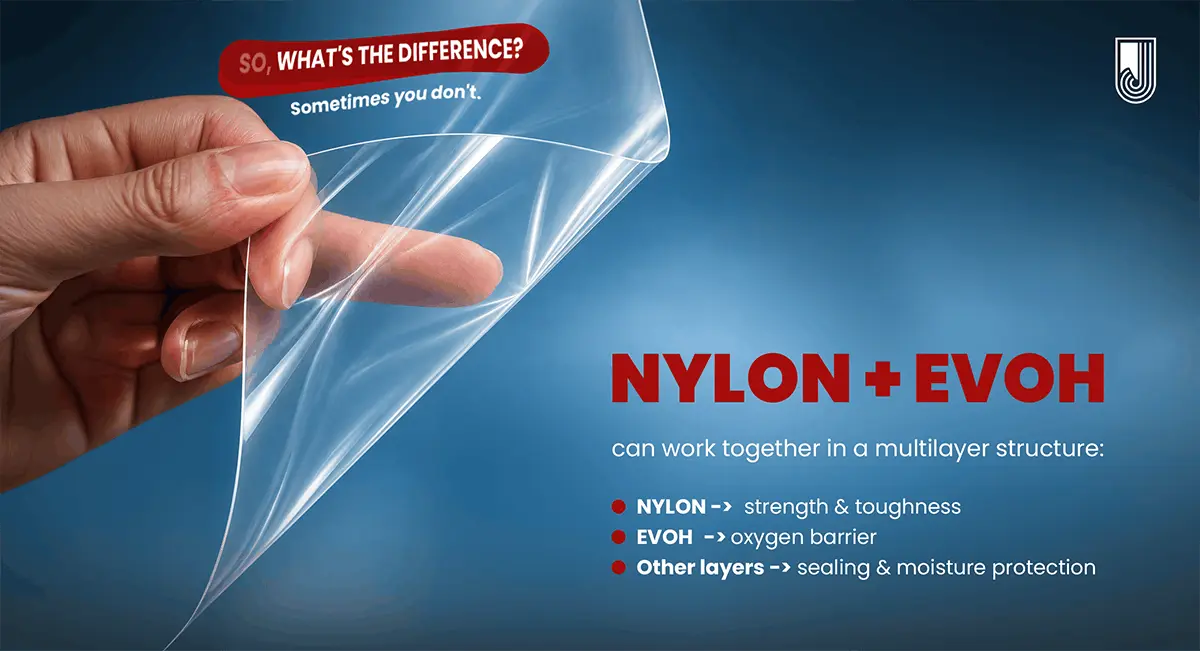
That is why nylon and EVOH are so often used together. A common core is PA / EVOH / PA: the nylon layers protect the EVOH, help the film form evenly, and keep the barrier intact when the film is stretched into a deep pocket. In vacuum pouches, nylon gives the strength to survive handling, stacking and transport without pinholes.
Why multilayer films have 5, 7 or 9 layers
Multilayer film packaging is made by co-extrusion: several polymers are melted separately and brought together in one die, so the film comes out as a single sheet with distinct layers. A typical 7-layer barrier film looks like this:
- Outer layer: polyethylene or polypropylene for gloss, printability and moisture protection
- Tie layer: bonds the outer layer to the nylon
- Nylon: strength and formability
- EVOH: the oxygen barrier
- Nylon: strength and protection for the EVOH
- Tie layer
- Sealant layer: the inside surface that heat-seals the pack shut
Going from 5 to 7 or 9 layers does not just add material. It lets the manufacturer split the nylon and EVOH into thinner, evenly spread layers, balance the structure so the film lies flat, and use each polymer where it does the most good. The result is often a thinner film that performs as well as, or better than, a thicker one with fewer layers.
How the film is cooled matters as well. Water-quenched blown film is cooled almost instantly as it leaves the die, which gives higher clarity and a film that forms more evenly. Our nine-layer films are made this way for that reason.
What about PVDC and other barriers?
EVOH is not the only option. PVDC is used in many barrier shrink bags because it holds its barrier well in humid conditions. Metallised films and foil laminates block light as well as oxygen, which suits coffee, dry snacks and powders. Each has trade-offs in clarity, recyclability, cost and how it behaves on the machine.
Matching the barrier to the food
There is no single “best” film. The right structure depends on what you are packing:
- Fresh red meat and poultry (vacuum or tray packed): high oxygen barrier with nylon for puncture strength. Bone-in cuts need extra thickness or a bone guard.
- Hard and sliced cheese: high barrier to stop mould. Cheeses that release gas while they mature need a structure designed for that, not a standard barrier film.
- Cooked meats, sausages and ready meals: high barrier, often in thermoforming films with an easy peel lid.
- Nuts, dry fruits and snacks: moisture and oxygen barrier, sometimes with light protection.
- Fresh fruit and vegetables: the opposite of a high barrier. Produce keeps breathing after harvest, so it needs a film that lets controlled amounts of gas through.
Questions to ask your film supplier
- What is the oxygen transmission rate, and at what temperature and humidity was it measured?
- How much does the barrier drop after the film is thermoformed or creased?
- What sealant layer is used, and will it seal through fat, brine or powder on the seal area?
- Is the film designed for my machine, whether that is a chamber vacuum packer, a thermoformer or a flow wrapper?
- Can the structure be down-gauged without losing shelf life?
The short version
A high barrier film is a carefully layered structure, not a single material. EVOH stops oxygen, nylon gives strength and formability, and polyethylene or polypropylene protect the EVOH and make the pack sealable. Getting that combination right is what makes EVOH packaging turn a few days of shelf life into a few weeks.
If you are reviewing your current packaging or launching a new product, talk to our team about JAQVA+ high barrier packaging films and the structure that suits your line.